
”Not the old, not the new, but the necessary,”
-Vladimir Tatlin
Constructivism
Constructivism was an artistic and architectural movement that began in Russia in 1913. Centrally, the Constructivists rejected the idea of art being autonomous from the rest of society: to them, all art and design was a political tool. Russia was their canvas, and the building of the new Soviet nation was one large project to construct. Early artists, such as Vladimir Tatlin, abandoned the artist’s traditional tools and techniques and adopted industrial materials. Tatlin was crucially influenced by Cubism and the three-dimensional still life made of scrap materials. He began to make his own but they were completely abstract and made from industrial materials. Russian artists that followed built on Cubism to develop Suprematism- a philosophy that sought to free art, design and architecture from dependence on traditional forms of representation. This new approach allowed free combination of primitive shapes, which served as building blocks for new artistic and architectural worlds. The Constructivists applied this abstract visual grammar with remarkable consistency across a wide range of design disciplines. Early Soviet graphic design is thus an unlikely mix of high avant-garde theory and political propaganda. This created what we know as the Constructivist “style”- which, ironically, was what they were trying to avoid.
“The material formation of the object is to be substituted for its aesthetic combination. The object is to be treated as a whole and thus will be of no discernible ‘style’ but simply a product of an industrial order like a car, an aeroplane and such like. Constructivism is a purely technical mastery and organisation of materials.”[1]
Constructivism became more than just an artistic movement. It was to serve as a new moral code by which one should live their life. The Realistic Manifesto (written by Nuam Gabo and Antoine Pevsner) declared that Constructivism was a general conception of the world. It aimed to cast aside tradition and at the same time rejected the notion of creating new traditions. It sought desperately to integrate Art and Life to the point that there was no longer “Art”, it was just “Life.” Artists were to be seen as workers, for the idea of the “artist” represented the bourgeois. Workers in the new constructivist era were to separate themselves from such conventions as use of lines, color, volume, and mass that were previously held sacred by artists. [2]
This new life was one that would be materialist without preconceived associations. The form an artwork would take would be dictated by its materials, and not the other way around. In the “Programme of the First Working Group of Constructivists” Alexander Rodchenko and other members declared:
“The task of the Constructivist Group is the communistic expression of materialist constructive work … The cognition of the experimental trials of the Soviets has led the group to transplant experimental activities from the abstract (transcendental) to the real …Down with art. Long live technic. Religion is a lie. Art is a lie …Long live the Constructivist technician.” [3]
Overall, the core of Constructivism was a desire to express the experience of modern life. Their leaders had the desire to develop a new form of art more appropriate to the democratic and modernizing goals of the Russian Revolution. Constructivists were to be constructors of a new society. They were cultural workers with the mind of scientists searching for solutions to their modern problems.
Gustav Klutsis
The Constructivist theorist and (dare I say) artist that I chose to focus on for my final assignment is Gustav Klutsis. I was initially drawn to his design work, however, I chose to follow him for his story.
Klutsis came to Russia from Latvia after being drafted into the Russian Army in 1917. It was there that he participated in overthrowing the tsar and assured a future for the new Soviet leaders, including Vladimir Lenin. Before joining the army, he had been an artist in his native home of Latvia. In 1919, he returned to art school in Moscow where he trained in the studio of Kazimir Malevich- who would go on to become one of the founders of Constructivism. Klutsis had a talent for spacial constructions, which made him a natural choice for the constructivist movement. In addition to being an accomplished constructivist, by the early 1920s, Klutsis had become a pioneering developer of photomontage. Klutsis applied photomontage to innovative designs for posters, magazines, and books throughout the 1920s and 1930s, and the technique was swiftly adopted by others members of the Soviet avant-garde. His technique became a defining feature of Constructivist artwork, and shared the stage alongside Rodchenko, El Lissitzky, and Stepanova as masters of Modernist art. [4]
After Stalin came to power in 1929, Klutsis’s Constructivist work changed to embody communist ideals. Under Stalin’s rule, artists had to abide by the rules of the state and could no longer work independently, or else suffer the consequences. Rather than face death, Klutsis created propaganda art supporting the communist regime. In the end, even abandoning his Constructivist heart could not save him. Stalin ordered a purge to eliminate challenge from past and potential opposition groups and solidify his future as Russia’s dictator. Therefore, many of the Constructivist artists, Klutsis included, were murdered by the communist party.
This tale of rising ideals, forced cooperation, and untimely demise served as the inspiration for the theme of my project.
As always, I started by analyzing Gustav Klutsis’s work before starting my design:
Formal Breakdown


Space
The political content takes up the majority of the image, which aligns with the Constructivist thinking for composing an image. The poster surface is and defined by the political content of the presented materials rather than by aesthetic principles. The content is positioned at the opitmal eye level of the viewer, in order to achieve the maximum expressive impact, political clarity and effective influence.

Material/ Form
Photography and the photograph are technical means for creating a representational form. The use of photo-montage here allows the artist to stay true to the nature of the material while crafting an image to serve a purpose.

Scale
The photomontage applies the use of different scales of the images to heighten the impact of the work. This method replaces the use of traditional/restrictive perspective rules- allowing for more compositional possibilities. The images are not thought of in terms of their original purpose, but rather a material that serves the object being created.

Color
This color palette was popular in this movement, with the vibrant red serving as a means for emphasis of the subject matter. Since Constructivists sought to reject color as an aesthetic means, color here was used more literally. Red was synonymous with the Russia and Communism in particular, so when used on propaganda posters, the color served the material.
Project:
Prompt: Early in the 20th Century, (say, 1910-1938) a massive leap in technology
allows for interplanetary travel. Earthlings are going to colonize Mars! The design and planning of this colony has been done by artists from your art movement! The entire spirit of the enterprise is determined by avant garde European artists.
This “brochure” should entice the “citizens of the future” to apply for a spot on the next colony transport.

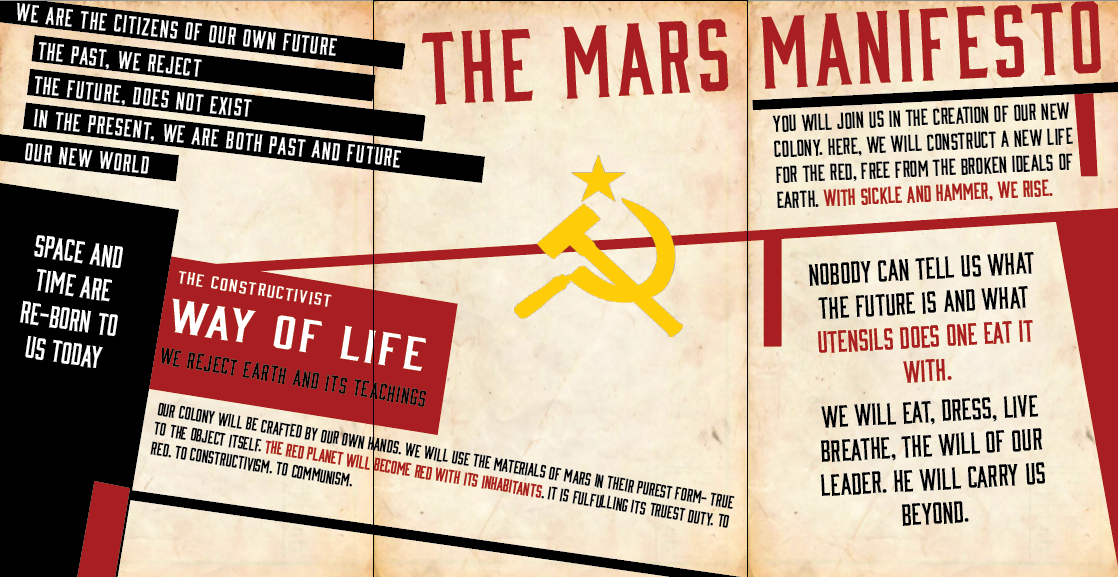
For this project, I decided to take a risk with the prompt and depict what it would be like if Constructivist artists were supposed to colonize Mars, except it was intervened by Stalin and the Communist regime. This brochure then “incites” them to colonize Mars not by trying to convince them, but by letting them know they have no other choice.
In the initial stages of my research, I wanted to define Constructivism in the simplest of terms. It can be quite confusing when reading translated documents to get a clear picture of what the Constructivist leaders were attempting to say, so I wanted to set the standard of what I would build my assignment on.
To summarize my findings:
The constructivists believed art should directly reflect the modern industrial world. Objective forms which were thought to have universal meaning were preferred over the subjective or the individual. Artwork was reductive, and pared down to the basic elements. New media, such as photography, photomontage, and film were used to carry out propaganda. Constructivists sought order, by rejecting the past and future and creating a present that would embody unity and understanding. Constructivist graphic design became influential, and was used later in the period when promoting communism.
Now that I had the basis of understanding, I began my visual search. I knew I wanted the majority of the work to reflect Gustav Klustis, but in order to bridge the gap of Constructivism and Communism, I sought inspiration from other sources as well. Aside from Klustis, I looked at El Lissistky for his take on geometric shapes as a precursor to graphic design. I also chose to look at propaganda from the Communist era. The propaganda posters that emerged from this time were usually done by an unknown artist, as it was illegal to be an individual artist not working for the country.
Visual Inspiration


![Gustav Klutsis, "Construction [Dynamic City]" 1921, Ink and gouache on paper](https://i0.wp.com/nspitzel701.home.blog/wp-content/uploads/2018/12/220px-gustavs_klucis_-_construction_-_google_art_project.jpg?ssl=1 "220px-Gustavs_Klucis_-_Construction_-_Google_Art_Project")
With sources gathered, I now had the task of breaking my project down into individual problems to be solved. Working with the Constructivist movement for this assignment posed a problem in itself- How would I represent a future with a movement so focused on the present? I ultimately decided to depict the present as the only path toward their ideal future. My designs would be based on the building of Mars as it were happening right now, with the text to advertise how they would build their future.

For my depiction of the Mars Colony, I was feeling pretty lucky that I had chosen a movement whose primary color was Red. However, I wanted to elevate Mars beyond a red circle in the sky. “Non-representational yet recognizable” became my mantra. It needed to embody the abstract geometric form of Constructivism while also conveying the purpose to the viewer. I decided to use photomontage combined with graphic shapes. The people placed throughout are the “citizens of the present”, as I’ve chosen to call them. They serve to act as the “worker” in constructing this new world.

Continuing on with my Present=Future theme, I wanted to depict the moment that the Russian workers arrive at Mars. I was initially inspired by Klutsis’s Untitled work (pictured left) as it reminded me of an abstract rocket launchpad. I then combined imagery of Russian workers from a propaganda poster with photos to show the constructing of the society.

The final part of the cover was meant to give way to Communism and Stalin’s reign. The Constructivist slogan minimizes and becomes a part of the rising Soviet flag. To show this descent, I wanted to capture the feeling that El Lissitzky’s lithograph was able to achieve. The flow of shapes gives a sense of unbalance, like it will fall at any moment. I found it appropriate for showing the fall of one movement into another. Klutsis did a number of propaganda works after Stalin came to power, so I used his work as a reference for the scale and composition of my imagery. Stalin was not a benevolent leader, and was quoted saying that Death would be the solution to mankind’s problems. He particularly wanted the death of all Russian agendas that came before him to pave an untainted path to his long rule. As a concept, it isn’t so different than the Constructivists wanting to “kill off” the way art had been thought of for generations. Albeit extreme, Stalin’s quote was a good way to bridge the two movements.
The Written Content
I decided to add an inside to the brochure, which would serve as the doctrine for the new colony. I designed the “Mars Manifesto” to be a combination of Constructivist and Communist ideals that the “Citizens of the Present” would read to get an idea of what their life on Mars would entail. I referenced “The Realistic Manifesto” by Nuam Gabo and Antoine Pevsner to get a feel for the writing style, and then I ran with it. Visually, graphic design during this time wasn’t build on a system of grids or structure. The shapes were meant to serve the purpose of the whole message, not to be an aesthetic choice. So in designing my layout, I simply went with what I felt would fit best. It has the same visual chaos that made El Lissitzky’s work so popular.
Since Constructivist artists weren’t fond of creative aesthetic design, I let the text speak for itself. Citizens of the Present would not need images of futuristic designed clothing or food, but rather would look to their leaders to decide for them. They would reject Earth and all it has brought before them, to carry their ideals to a place that couldn’t be more fitting for Communist Constructivists- The “Red” Planet.
As always, Thank you for reading!
That’s it for this semester, keep reading, keep learning, keep growing.
-Natalie Spitzel
Notes
[1] Nuam Gabo and Antoine Pevsner, “The Realistic Manifesto,” ART THEORY, , accessed December 07, 2018, http://theoria.art-zoo.com/the-realistic-manifesto-gabo-pevner/.
[2] Ibid.
[3] Bruce R. Elder, Harmony and Dissent : Film and Avant-Garde Art Movements in the Early Twentieth Century, Waterloo, ON: Wilfrid Laurier University Press, 2008, Accessed December 6, 2018, ProQuest Ebook Central.
[4] “The Art Institute of Chicago,” Art Access: Rococo to Realist Art | The Art Institute of Chicago, , accessed December 07, 2018, http://archive.artic.edu/avant-garde/klutsis/.
 A Study of Style through History